Safety

At Navya Mobility, safety drives every innovation. Our autonomous vehicles, built for both private sites and public roads, place the protection of passengers and all road users at the core of their design and deployment.

our philosophy

Provable safety

The transition from a human driver to an autonomous system represents a fundamental shift in responsibility. Our safety philosophy is based on a fundamental principle:provable safety.

It is not just about believing our vehicles are safe, but about proving it through rigorous processes, exhaustive validation, and complete transparency.

Our commitment is built on three pillars:
Robust Design

Integrating safety from the very first line of code and the first design schematic.

Exhaustive Validation

Running our systems through large volume of scenarios in simulation before any real-world deployment.

Rigorous Adaptation

Applying the strictest safety standards based on the vehicle's operating environment

On open roads

On Open Roads:
The Rigor of ISO 26262

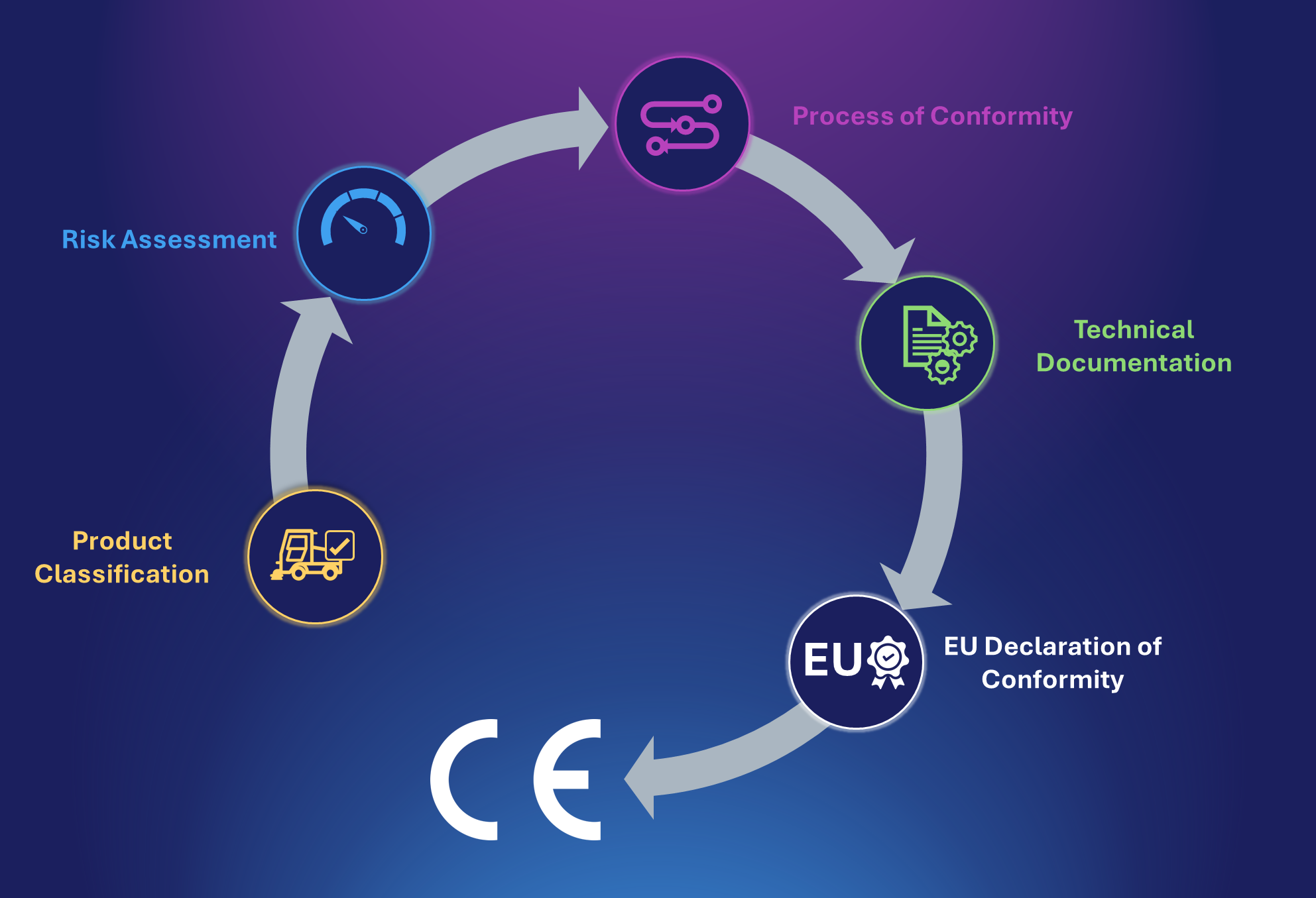
In controlled environments like factories, warehouses, or large business parks, our vehicles are considered machinery. They therefore comply with the European regulations on machinery (currently Regulation (EU) 2023/1230, replacing Directive 2006/42/EC).

Lorem ipsem dolor eras neus

Mastery of the Machinery Directive

Our CE marking process ensures that the vehicle is intrinsically safe for operators and nearby people:

Comprehensive Risk Analysis

We assess all mechanical, electrical, and operational risks specific to the site's environment.

Compliant Design

We integrate the Essential Health and Safety Requirements (EHSR) from the design phase (e.g., emergency stop buttons, proximity detection systems).

Compilation of the Technical File

We document all analyses, diagrams, and tests proving the vehicle's conformity.

Declaration of Conformity and CE Marking

We certify that our vehicle meets all regulatory requirements, authorizing its commissioning on the site.

On Private sites

On open roads

On Open Roads:
The Rigor of ISO 26262

For our vehicles intended for public roads, the international standardISO 26262 "Road vehicles - Functional safety"is our benchmark. It provides us with a systematic methodology for managing risks related to potential failures of electrical and electronic systems.

Our ISO 26262 process includes:

The Rigor of ISO 26262 

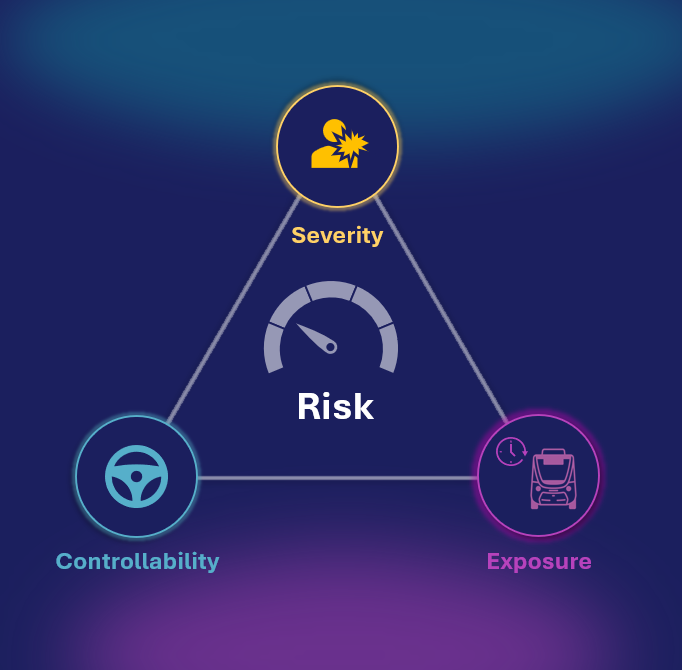
We identify all potential hazards (e.g., unintended acceleration). For each hazard, we assess its risk level based on three factors:

Severity (S)

The severity of potential consequences.

Exposure (E)

The likelihood of being in the situation where hazard can occur.

Controllability (C)

The ability of a human driver to avoid the accident if the failure occurs.

On Open Roads

ASIL Determination

The result of the HARA allows us to assign an Automotive Safety Integrity Level (ASIL) to each function, ranging from A (lowest) to D (most critical). An ASIL D function, such as autonomous braking, requires the highest level of rigor in design, testing, and validation.

No items found.

FAQs

Lorem ipsum dolor sit amet, consectetur adipiscing elit. Suspendisse varius enim in eros elementum tristique.

Question text goes here

Lorem ipsum dolor sit amet, consectetur adipiscing elit. Suspendisse varius enim in eros elementum tristique. Duis cursus, mi quis viverra ornare, eros dolor interdum nulla, ut commodo diam libero vitae erat. Aenean faucibus nibh et justo cursus id rutrum lorem imperdiet. Nunc ut sem vitae risus tristique posuere.

Question text goes here

Lorem ipsum dolor sit amet, consectetur adipiscing elit. Suspendisse varius enim in eros elementum tristique. Duis cursus, mi quis viverra ornare, eros dolor interdum nulla, ut commodo diam libero vitae erat. Aenean faucibus nibh et justo cursus id rutrum lorem imperdiet. Nunc ut sem vitae risus tristique posuere.

Question text goes here

Lorem ipsum dolor sit amet, consectetur adipiscing elit. Suspendisse varius enim in eros elementum tristique. Duis cursus, mi quis viverra ornare, eros dolor interdum nulla, ut commodo diam libero vitae erat. Aenean faucibus nibh et justo cursus id rutrum lorem imperdiet. Nunc ut sem vitae risus tristique posuere.

Question text goes here

Lorem ipsum dolor sit amet, consectetur adipiscing elit. Suspendisse varius enim in eros elementum tristique. Duis cursus, mi quis viverra ornare, eros dolor interdum nulla, ut commodo diam libero vitae erat. Aenean faucibus nibh et justo cursus id rutrum lorem imperdiet. Nunc ut sem vitae risus tristique posuere.

Question text goes here

Lorem ipsum dolor sit amet, consectetur adipiscing elit. Suspendisse varius enim in eros elementum tristique. Duis cursus, mi quis viverra ornare, eros dolor interdum nulla, ut commodo diam libero vitae erat. Aenean faucibus nibh et justo cursus id rutrum lorem imperdiet. Nunc ut sem vitae risus tristique posuere.